
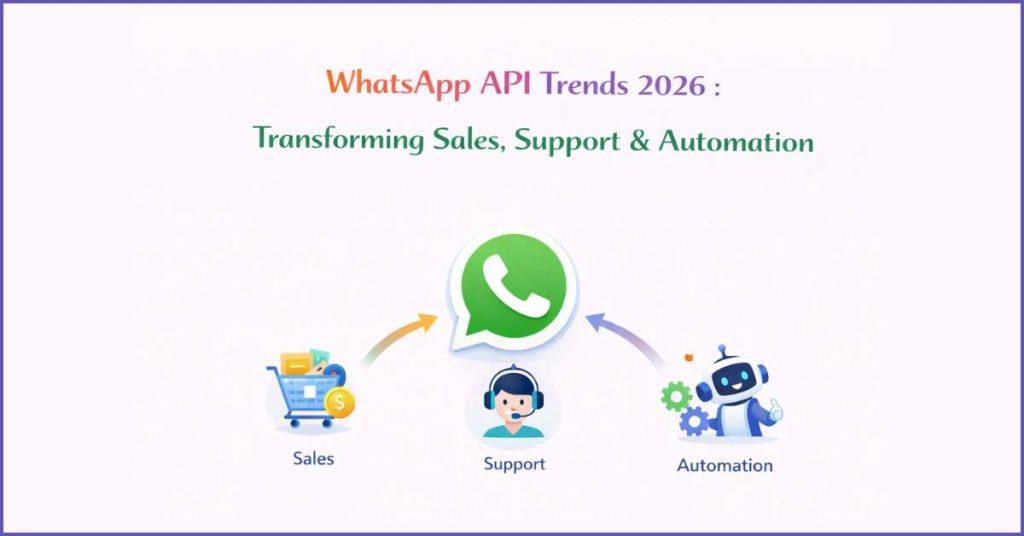
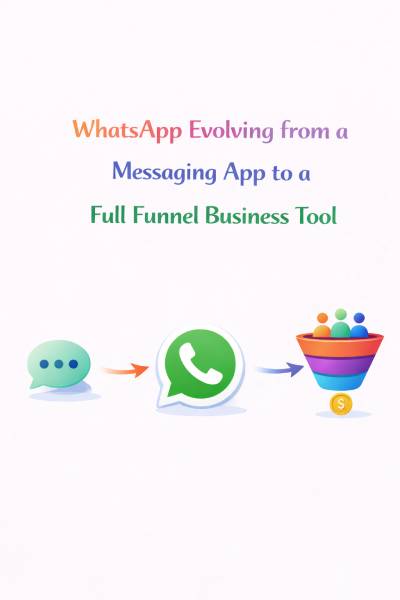
WhatsApp Evolving from a Messaging App to a Full Funnel Business Tool :
WhatsApp has evolved from a simple messaging app into a comprehensive business engine. It functions as the primary “operating system” for customer interaction. By blending high trust communication with advanced automation via the WhatsApp Business API, enterprises can now manage the entire customer journey from discovery through “Click-to-WhatsApp” ads to native in-chat payments within a single, frictionless thread.
This transition to “Agentic Commerce” allows businesses to automate up to 70% of support & sales tasks. It uses AI that understands intent & executes complex workflows like booking or catalogue management. As we move forward, the platform is becoming a searchable, hyper-personalized archive. It replaces cluttered email & SMS. Thus, making real-time, conversational engagement the standard for global business growth.
Key WhatsApp API Trends for 2026 :
Trend #1: WhatsApp Flows & The Death of External Links
The introduction of WhatsApp Flows has turned chat windows into interactive apps. Instead of clicking a link that takes you to a slow-loading website, you can now fill out forms, pick a seat on a flight, or choose a time slot for a haircut directly inside the chat. This keeps the user focused and dramatically reduces “drop-off” rates. Thus, making the experience feel fluid and integrated.
Trend #2: AI Agents Over Human Support
We have moved past the era of “dumb” chatbots that don’t understand context. Modern AI-powered agents use real-time data to solve problems. It can be processing a refund or troubleshooting a technical issue. By providing 24/7 availability & instant response accuracy, businesses are seeing a massive drop in operational costs. Thus, customers enjoy a frustration-free support experience.
Trend #3: Automated Commerce & Revenue
WhatsApp is now a full-service digital storefront. Automated commerce journeys use AI to suggest products. It is on the basis of a user’s history, sending personalized “back-in-stock” alerts & facilitating the entire checkout process. By creating a personalized “personal shopper” feel, automation is driving higher average order values. It turns simple conversations into consistent revenue streams.
Trend #4: The New Notification Gold Standard
WhatsApp has massive open rates. It has officially replaced email and SMS for enterprise notifications. Whether it’s a banking OTP, a flight delay alert, or a delivery update, businesses prefer WhatsApp. It offers “rich” communication and allows users to click buttons or track packages on a map. It is simply not possible with traditional text messaging.
Trend #5: Centralized Omnichannel Automation
Enterprises are now using WhatsApp as the “central nervous system” of their communication. Instead of managing five different platforms, companies are syncing their WhatsApp API with their CRM. It helps to ensure that whether a customer reaches out via Instagram, email, or a website, the conversation continues seamlessly on WhatsApp. This creates a unified brand voice and simplifies campaign management.
Trend #6: Security and Governance
With great data comes great responsibility. As businesses scale their automation, compliance and template governance have become non-negotiable. Strict policies ensure that users aren’t spammed & that their data is encrypted & handled according to local laws. Staying compliant is now a strategic advantage that builds long-term customer trust.
Trend #7: Voice and Vernacular Growth
In markets like India, the API is breaking the language barrier through voice enabled AI. Customers can now send a voice note in their native dialect. The AI will translate and process the request instantly. This makes digital commerce accessible to millions of users who prefer speaking over typing. It opens up entirely new demographic segments for brands.
Trend #8: Full-Funnel Infrastructure
WhatsApp is no longer just for support. It now handles the entire buyer journey. Right from the first “Click-to-WhatsApp” ad to automated KYC/onboarding and final payment. Businesses are building entire “mini-apps” inside the chat via WhatsApp Flows. Thus, making the mobile web almost obsolete for many transactions.
Trend #9: Intent-Driven Lead Generation
Lead generation has shifted from passive forms to active conversations. Instead of capturing an email and hoping for a reply, the “lead” is a live chat thread. The moment a user taps an ad, the business receives a verified name and number. It allows AI to qualify the prospect’s intent and budget instantly.
Trend #10: Native Business Calling
WhatsApp Business Calling has become an official API feature. It allows agents to switch from chat to a VoIP voice call within the same window. This is critical for high-value sales like real estate, luxury goods or complex support cases where a human voice is needed to close a deal or calm a frustrated user.
Trend #11: AI-Assisted Inbox Management
AI is now “inside” the agent’s dashboard. It doesn’t just talk to customers. It helps human agents by summarizing long chat histories. Also it suggest the best response templates, and translating incoming messages in real-time. This keeps communication consistent even as teams scale.
Trend #12: Real-time CX Scoring
Waiting for a “Post-chat Survey” is over. AI now automatically scores every interaction based on sentiment, resolution speed & customer effort. Managers get a live “Health Score” for their customer experience (CX). It does not require the user to fill out a single rating button.
Trend #13: Sales Performance Tracking
WhatsApp is now a legitimate sales performance system. It tracks which chat flows lead to the most revenue, which agents close deals fastest, and the exact ROI of every “broadcast” campaign. This data allows sales directors to optimize their scripts & workflows with surgical precision.
Trend #14: Operational CRM Sync
Integration with CRMs has moved from “syncing contact info” to triggering business operations. A message on WhatsApp can now automatically update an inventory database. It triggers a warehouse shipping label, or generates a legal contract in the backend.
Trend #15: Omnichannel “Default”
Enterprises now use WhatsApp as their central communication hub. If a customer starts a query on Instagram or a website, the system automatically redirects the continuity to WhatsApp. This ensures the user never has to repeat themselves, as the entire history follows them across platforms.
Trend #16: Re-engaging “Silent” Customers
Automation now targets users who have gone “dark.” If a customer stops responding during a booking flow, the API triggers a timed, non-intrusive nudge or a personalized offer to bring them back. This “follow-up automation” is recovering billions in previously lost revenue.
Trend #17: Simplified Access & Login
The friction of setting up the API has vanished. With Embedded Signup and Single Sign-On (SSO), businesses can go live in minutes. For consumers, “Login with WhatsApp” has replaced complex passwords and email OTPs. Thus, making it the universal digital key for apps and services.

Why is Botbuz Built for WhatsApp Business API Success in 2026 ?
Botbuz serves as the essential bridge between the WhatsApp Business API’s raw potential and actual enterprise growth. It simplifies high-level trends into a single, no-code dashboard. The platform transforms the chat window into an interactive “mini-app”. It uses WhatsApp Flows and deploys Agentic AI that moves beyond simple replies to execute real-world tasks. It can update CRMs, process payments, and handle VoIP calls.
It centralizes omnichannel communications & automates the “silent” parts of the sales funnel such as lead qualification & abandoned cart recovery. Botbuz converts WhatsApp from a mere messaging tool into a high-ROI sales performance system. It can handle, scale, provide security & multilingual support effortlessly.
Conclusion :
The evolution of the WhatsApp Business API marks the end of fragmented customer journeys. It replaces them with a unified, “everything in chat” ecosystem where Botbuz acts as the primary architect. It turns the platform into a full-fledged infrastructure. Also it is capable of everything from AI driven lead qualification to native voice calling and automated payments. Thus, Botbuz allows enterprises to capitalize on real-time engagement without the technical overhead.
Ultimately, these trends prove that the future of commerce is no longer about directing users to external sites. But about using Agentic AI & seamless automation within a single thread to drive measurable ROI. It ensures that every conversation is a high-value opportunity for growth.
FAQs :
- How do “WhatsApp Flows” improve conversion rates?
They turn a chat into a “mini-app”. It allows users to fill out forms or book appointments without leaving the window. By removing the need to visit external websites, Botbuz users see a massive reduction in drop-off rates and much faster checkouts.
- Can AI Agents really handle complex support issues?
Yes, 2026-era AI Agents go beyond simple scripts to understand context and intent. Using Botbuz, they can access real-time data to solve specific problems—like processing a return or checking stock—autonomously and accurately.
- Is WhatsApp Business calling an official part of the API?
Yes, native VoIP calling is now a standard trend. It allows agents to switch from text to voice within the same chat thread, which is essential for closing high-value deals or resolving sensitive issues that require a human touch.
- How does Botbuz recover “silent” or abandoned leads?
The platform monitors user behavior and automatically triggers a timed, personalized “nudge” if a customer stops responding during a purchase. These automated follow-ups are far more effective than traditional emails for reclaiming lost revenue.
- Can I reach customers who speak different regional languages?
Absolutely. Botbuz uses Voice and Multilingual AI to detect and respond in the customer’s preferred dialect. It can even transcribe voice notes into data, making your business accessible to users who prefer speaking over typing.
- How does syncing WhatsApp with my CRM drive ROI?
It turns your chat into an operational hub. By syncing with tools like Salesforce, Botbuz ensures every conversation is informed by the customer’s purchase history, enabling hyper-personalized offers that increase the total value of every customer.
- Is it difficult to stay compliant with WhatsApp’s policies?
No, because Botbuz automates Template Governance. It handles the approval process for messages and manages customer opt-ins/opt-outs, ensuring your account stays in good standing with Meta and local data privacy laws.


