
- How Product Search has Evolved in E-commerce ?
- Introducing Conversational AI :
- Why Traditional Product Filters and Search Are Outdated ?
- What is Conversational AI Product Search?
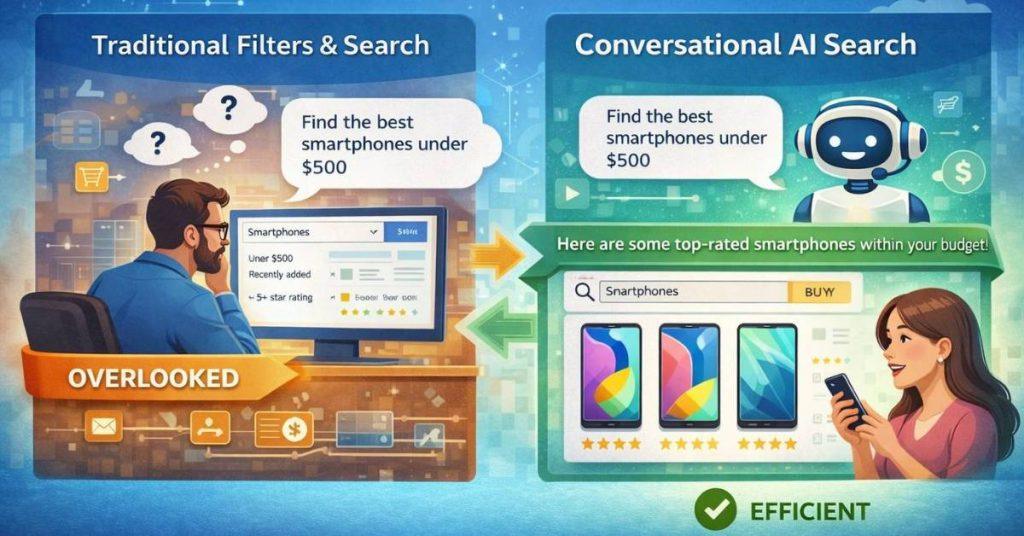
- Traditional Search vs. Conversational AI :
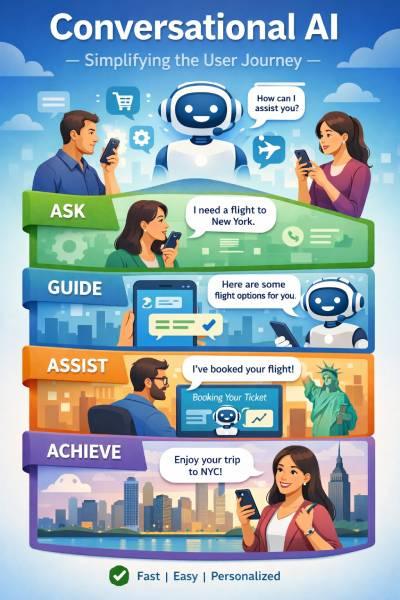
- How Conversational AI Simplifies the User Journey ?
- The Technology Behind Conversational AI Product Search :
- How Businesses Can Implement Conversational AI ?
- Use Cases of Conversational AI Replacing Filters :
- Botbuz AI Agents : Beyond Basic Product Search
How Product Search has Evolved in E-commerce ?
E-commerce discovery started with simple, static tools like category browsing and basic keyword search. If you wanted a specific product, you had to know exactly what keywords to use. Today, it has evolved into an intelligent, dynamic process. It uses AI to personalize results and predict what you might want.
The tools users still rely on the search bar & traditional filters. They are often frustrating. The search bar is too rigid. It struggles with typos, synonyms, and any kind of complex, descriptive request. For e.g., “a casual winter coat”. Filters are also clunky. Clicking through many drop-down menus often leads to a quick dead-end of “zero results”. It makes shoppers feel misunderstood.
Introducing Conversational AI :
Conversational AI is the modern solution. It uses advanced technology to understand natural language. It means you can talk to the website or app the same way you’d talk to a friend or a human store associate. Instead of typing keywords, you can ask a full, descriptive question. The AI understands the underlying intent and provides highly relevant, curated results.
Modern shoppers are used to interacting with smart assistants like Siri or Alexa. They expect the same level of intelligence from e-commerce sites. They want an experience that is fast, personalized, and intuitive. They are looking for a dialogue, not a difficult directory. Thus, making a natural, conversational shopping experience an essential expectation today.
Why Traditional Product Filters and Search Are Outdated ?
Traditional e-commerce filters and search methods are falling behind. It is because they aren’t smart enough for modern shoppers.
Filters use fixed categories (like color or size) that force you to shop in a very specific, limited way. This structure often doesn’t align with the real-world, complex things you are actually searching for. It makes the experience feel unnatural and stiff.
Customers often look at a huge list of filter options and feel overwhelmed. They don’t know the specific terms or the perfect combination of choices they need to select. Thus, making it hard to find the right product without guidance.
Manually clicking through filters is slow and tedious. If you select too many and get “no results,” you have to waste time going back and removing them one by one. This turns product searching into a long, frustrating task.
Standard search bars demand perfect accuracy. A simple typo or using a slightly different word (a synonym) often results in a useless “zero results” page. The system looks for an exact match and fails to understand what you meant to find.
What is Conversational AI Product Search?
Conversational AI Product Search is a new method for finding items online. Instead of clicking rigid buttons, you talk to the e-commerce site using natural language, just like you would talk to a real person in a store.
This search allows you to describe exactly what you want using full, descriptive sentences. For example, you can say: “Show me lightweight running shoes under ₹3000” or “I need a large, simple coffee maker.” The system handles all the details at once.
The core of this system is Natural Language Processing. It helps the computer understand human speech. It uses Intent Detection to figure out why you are asking (are you searching, or asking about a policy?).
The AI then uses Preference Interpretation to pull out all the key constraints from sentences—like “lightweight,” “running shoes,” and “under ₹3000.” These become the filters, but without you having to select them manually.
If your initial query is too vague, the AI engages in a Guided Dialogue Flow. It asks smart follow-up questions. For eg. “Are you looking formal or casual?”. It helps to quickly narrow down the options, acting like a helpful personal shopper.
Traditional Search vs. Conversational AI :
|
Topic
|
Traditional Search
|
Conversational AI
|
|---|---|---|
|
Interaction Style
|
Traditional search uses manual clicks and rigid keywords, making it easily error-prone.
|
Conversational AI uses natural language, allowing for fluid, human-like dialogue that understands the context of what you're saying.
|
|
Personalization Level
|
Traditional search offers very limited personalization.
|
Conversational AI, however, is much smarter. It uses everything about you—your current request, your past purchases, and your preferences—to provide truly refined, custom-tailored recommendations.
|
|
Speed and Efficiency
|
Finding products the old way is slow; you have to spend time manually clicking filters and scrolling through pages.
|
Conversational AI is fast. It understands your complex needs instantly and uses dialogue to quickly narrow down options, saving you significant time.
|
|
Impact on Sales (Conversion)
|
This better experience directly boosts business. By eliminating frustration and avoiding the dreaded "zero results,"
|
Conversational AI reduces drop-offs. It keeps users engaged and guides them quickly to the product they intend to buy, resulting in higher conversion rates.
|
How Conversational AI Simplifies the User Journey ?
Conversational AI completely streamlines the journey for the shopper. It makes it simple and quick.
Talk, Don’t Click
Instead of wasting time manually clicking through filters, users can just describe what they want using simple, everyday language. The AI uses Natural Language Understanding. It helps to automatically grasp all the details—like the size, color, and price—without the user doing any manual selection.
Helpful Guidance
If your initial request is too broad (“Show me a sweater”), the AI steps in like a smart store associate. It automatically asks clarifying questions like “Wool or cotton?”. This eliminates the customer’s guesswork & quickly guides them to the right product category.
Instant, Smart Results
The AI doesn’t just match words. It instantly checks various data points like current requests, past purchases & even current trends. This allows it to generate instant, highly intelligent product recommendations that are much better than simple, static filter results.
Truly Personalized Shopping
This process delivers a genuinely personalized experience. The recommendations are tailored based on unique behavior and conversation history. It makes feel understood & ensures that the search results are perfectly suited to tastes, not just a generic list.
The Technology Behind Conversational AI Product Search :
The technology powering Conversational AI product search is built on a sophisticated stack of AI tools. Natural Language Processing is the foundation. It enables the system to understand the user’s intent, context & full meaning of their query. Thus, moving beyond simple keyword matching. Machine Learning models learn from every interaction, constantly improving personalization. It predicts which products are most relevant to an individual user over time.
A Knowledge Graph structures all product data and relationships. It allows the AI to reason about product features like a human sales associate. Finally, this system is integrated with existing recommendation engines. It helps to provide holistic suggestions & it supports multi-modal inputs like voice & image alongside text. Thus, offering a comprehensive and flexible search experience.

How Businesses Can Implement Conversational AI ?
To implement Conversational AI, businesses integrate the technology into various customer touchpoints. This typically involves deploying AI Chatbots on the main website. It helps to serve as real-time virtual assistants for discovery and service. Also extending this capability to messaging apps like WhatsApp for seamless, omnichannel shopping.
Crucially, the AI must be integrated with internal systems like Product Databases (PIM) and CRM. It helps to ensure accurate inventory data & personalized recommendations based on customer history. Finally, upgrading the main website search bar into an AI-Powered Search Widget allows users to input natural-language queries directly. It streamlines the initial product discovery process.
Use Cases of Conversational AI Replacing Filters :
Conversational AI is proving its effectiveness across diverse retail categories. Also it demonstrates its ability to handle nuanced, descriptive queries that traditional keyword searches & filters simply cannot process.
Fashion & Apparel Product Recommendations :
In fashion, discovery is driven by style, occasion, and mood. They are impossible to filter mechanically.
Traditional Problem : A user searches “dress,” and then has to manually select filters for “color: black,” “price: under ₹2000,” and “occasion: party.”
Conversational Solution : The user types or speaks the single phrase: “I need a black party dress under ₹2,000.” The AI instantly understands the complex combination of attributes like color, occasion, budget. It returns highly relevant results immediately, bypassing the tedious filter clicks.
Electronics & Gadgets Search :
Electronics require the AI to understand. It helps to prioritize complex technical specifications and user context.
Traditional Problem : A user is forced to filter by rigid specs like “RAM,” “CPU,” and “display size.”
Conversational Solution : The user asks : “Recommend a good laptop for coding under ₹60,000.” The AI understands that “coding” is a proxy for high-performance needs. For eg, fast processor, plenty of RAM, dedicated graphics. It uses this inferred intent to filter the products. Thus, providing personalized recommendations based on usage, not just rigid specs.
Beauty & Skincare Finder Tools :
In beauty, search is deeply personal and often diagnostic. Conversational AI acts as a digital consultation tool.
Traditional Problem : Users must manually select a “skin type” filter. It often does not know the exact type. For e.g., combination, sensitive, dehydrated.
Conversational Solution : The user states : “Suggest a skincare routine for oily skin.” The AI can then engage in a guided dialogue: “Are you prone to breakouts? Do you prefer fragrance-free products?” . It uses this multi-turn input, sometimes combined with image analysis. Thus, building a comprehensive, multi-step routine with specific products, replacing dozens of static filter clicks.
Home Decor & Furniture Assistance :
Furniture searches involve complex spatial constraints and aesthetic judgments.
Traditional Problem : A user sees a “sofa” filter, but there is no simple filter for “small,” “modern,” or “fits in a corner.”
Conversational Solution : The user requests: “Looking for a small sofa for a studio apartment.” The AI understands “small” in the context of “studio apartment” for e.g., less than $1.5$ meters wide, maybe a loveseat or sleeper. It filters for style attributes like “modern” or “space-saving design,”. Thus, solving a complex dimensional and aesthetic problem instantly.
Grocery and Daily Needs :
For routine shopping, Conversational AI focuses on speed, budget, and recurring needs.
Traditional Problem : Finding products based on a general need like “budget-friendly” or “high-protein”. It requires checking multiple categories and comparing prices manually.
Conversational Solution : The user commands: “Add budget-friendly breakfast options to my cart.” The AI instantly combines the product category (“breakfast options”) with the constraint (“budget-friendly”). It automatically selects and adds the lowest-priced, highest-rated relevant items to the cart. Thus, streamlining the routine task of grocery shopping.
The common thread across all these use cases is the AI’s ability to seamlessly translate complex, human language into precise, machine-executable search criteria. Thus, making product discovery collaborative and efficient.

Botbuz AI Agents : Beyond Basic Product Search
Botbuz AI Agents transform the e-commerce journey. It offers a deep, human-like conversational experience that goes far beyond simple keyword search. They use intelligent dialogue to provide dynamic product recommendations. It is done by analyzing context, preferences, and user history in real-time.
These agents facilitate seamless WhatsApp Commerce. It allows customers to complete the entire shopping journey. Right from product discovery to checkout, within the chat interface. Crucially, their support extends to comprehensive post-purchase engagement. It handles order tracking, FAQs, and personalized offers. Thus turning generic browsing into a continuous, guided, and highly personal shopping experience. Thus, driving engagement and loyalty across all touchpoints.
Conclusion :
Conversational AI is replacing outdated, rigid e-commerce filters and search bars. It is because it offers a superior user experience based on natural language understanding, context & intent. This shift meets customer demand for faster, more personalized shopping.
Botbuz AI Agents exemplify this new approach. It offers human-like, dynamic recommendations and supports the entire customer journey, including through seamless WhatsApp Commerce. Businesses adopting this technology gain a competitive edge. It transforms their online stores into guided, engaging retail experiences. Thus, driving higher conversion and loyalty.