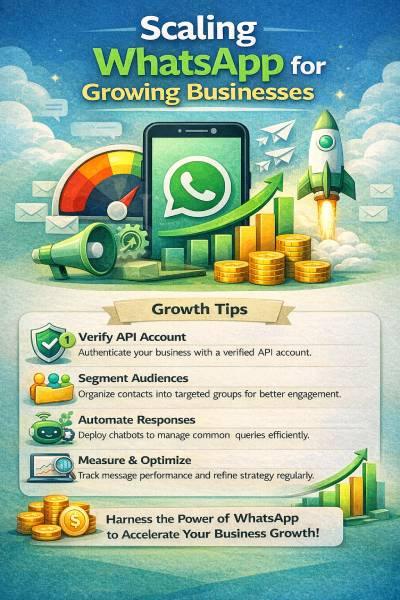
- Scaling WhatsApp for Growing Businesses :
- Multi-Agent Setup : Managing High Conversation Volumes
- Multi-Team Architecture : Supporting Multiple Departments
- Multi-Country WhatsApp API Deployment :
- Centralized vs Decentralized WhatsApp Infrastructure :
- Automation & Chatbots in Scaled WhatsApp Systems :
- Best Practices for Scaling WhatsApp API Successfully :
- Setting Up Multiple Agents on WhatsApp Business Through Botbuz :
- FAQs :
Scaling WhatsApp for Growing Businesses :
Scaling WhatsApp infrastructure has become a business necessity. It is because the platform is now a primary channel for global commerce and support. The companies move beyond small-scale messaging. They must transition from limited phone-based apps to robust API-driven environments. It supports unlimited agents and deep CRM integration.
This shift is driven by the need to manage high-volume conversations. It is across different time zones and languages while navigating complex regional regulations and Meta’s strict quality standards. Ultimately, scaling effectively allows a global enterprise to maintain a unified brand presence. It provides 24/7 responsiveness without sacrificing the personal, local feel of a one-on-one chat.
Multi-Agent Setup : Managing High Conversation Volumes
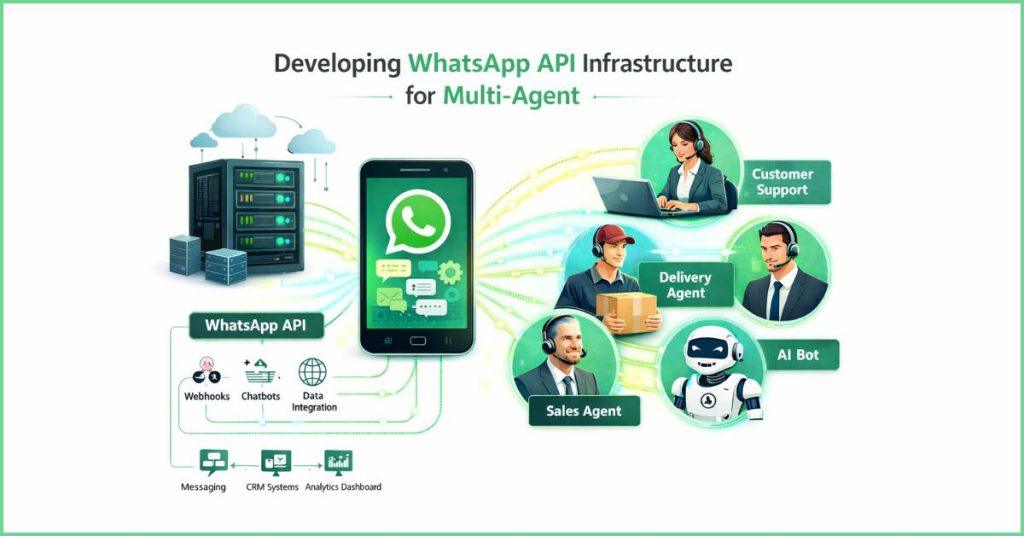
A Multi-Agent WhatsApp API setup transforms a single business number into a high-capacity communication hub. It allows unlimited team members to collaborate within a centralized dashboard. Unlike the standard Business App, which is limited to a few devices and manual oversight, the API enables automated routing and conversation ownership. Thus, ensuring that messages are intelligently distributed rather than being “cherry-picked” by agents.
By integrating AI Agents as a first line of defense to handle routine FAQs, businesses protect human bandwidth. It ensures 24/7 responsiveness. This structured approach, supported by internal collaboration tools like private notes & CRM syncing. It prevents the common bottlenecks of manual scaling. Thus, ensuring a seamless experience for customers regardless of which agent or bot they are speaking to.
Multi-Team Architecture : Supporting Multiple Departments
Multi-team WhatsApp management prevents organizational chaos. It transforms a single business number into a structured enterprise switchboard. Instead of letting messages pile up in one messy inbox, intent-based AI routing automatically directs queries to the correct department. It can be Sales, Support, or Billing—based on what the customer needs.
This setup uses Role-Based Access to ensure data security. Also it allows for specialized reporting. It tracks the performance of individual teams rather than just total message volume. Ultimately, this approach enables a company to scale its operations and automate lead qualification without the confusion of managing multiple different phone numbers.
Multi-Country WhatsApp API Deployment :
Multi-country WhatsApp operations allow global enterprises to maintain a local feel while managing massive scale through a combination of localized numbers and centralized AI. By utilizing country-specific virtual numbers, businesses build trust and improve delivery rates. Multilingual AI agents provide instant, 24/7 support. It automatically detects languages & switching conversation flows.
This infrastructure is reinforced by shift-based routing. It seamlessly transfers chats to “awake” teams across different time zones. Also it ensures low response times, and automated compliance tools. Thus, managing regional data privacy laws like GDPR and LGPD.
Centralized vs Decentralized WhatsApp Infrastructure :
Choosing the right infrastructure model involves balancing global oversight with local agility. A centralized model provides a single source of truth for brand voice and analytics. It makes it ideal for maintaining strict security & consistent customer experiences across all regions.
Conversely, a decentralized approach empowers local teams to move faster. It allows them to tailor messages to regional nuances. Also it reacts instantly to local market shifts. Most modern enterprises now adopt a hybrid infrastructure. It uses centralized governance to manage core security and data integration while giving local offices autonomy. Thus, executing region-specific campaigns and support strategies.
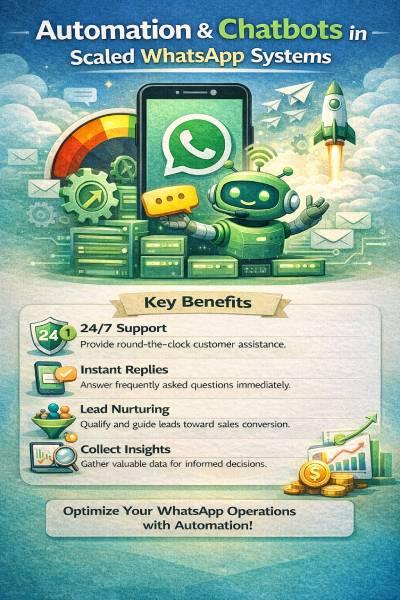
Automation & Chatbots in Scaled WhatsApp Systems :
Automation is the “engine” that allows a WhatsApp system to scale without a linear increase in headcount. By using AI-driven chatbots as a first responder, businesses can instantly resolve routine tasks. It can resolve FAQ handling, lead qualification, and real-time order updates, which typically account for 80% of incoming traffic.
This system uses intelligent routing rules to ensure that while simple queries are handled by bots. Also it provides high-value or complex issues which are seamlessly escalated to the right human agent with full context. Ultimately, automation doesn’t replace the human touch. It preserves it by freeing up the team to focus on meaningful, empathetic conversations rather than repetitive administrative tasks.
Common Scaling Challenges & How to Overcome Them :
Scaling challenges like message overload and inconsistent branding are overcome by shifting from manual work to intelligent infrastructure. To prevent agent burnout, AI deflection layers filter out routine queries. While parameterized templates bypass regional approval delays by allowing a single pre-approved message to be customized globally.
Consistency is maintained through AI co-pilots. It suggests standardized responses to agents in any country. Thus, ensuring a unified brand voice regardless of location. Finally, by syncing all interactions to a centralized CRM, businesses eliminate customer frustration. It ensures that context follows the user across every bot and human interaction.
Best Practices for Scaling WhatsApp API Successfully :
To scale WhatsApp API successfully, business must move from a reactive setup to an integrated, AI-first architecture. It treats messaging as a core part of your tech stack. This involves utilizing the high-throughput capabilities of the Cloud API. It standardizes workflows across departments to ensure a consistent brand voice. Thus, deploying intent-based AI routing to eliminate manual triage.
By centralizing operations under a single verified number while automating regional compliance and lead qualification, businesses can expand globally without increasing complexity or headcount. Ultimately, the goal is to build a “future-proof” system where automation handles the volume. It leaves human agents free to focus on high-value customer interactions.

Setting Up Multiple Agents on WhatsApp Business Through Botbuz :
Botbuz simplifies the transition to a professional WhatsApp API environment. It provides a centralized platform that eliminates the limitations of standard business apps. Through its embedded signup, businesses can instantly connect an official API account to a shared team inbox. Thus, allowing unlimited agents to collaborate on a single number with advanced features like number masking and internal notes.
The platform’s no-code chatbot builder and intent-based routing act as a first line of defense. It automates routine tasks and lead qualification before seamlessly handing off complex queries to human agents. This structured approach allows companies to scale across multiple teams & countries without added complexity. Thus, ensuring high-quality, 24/7 responsiveness through a unified dashboard.
Conclusion :
Scaling WhatsApp infrastructure through Botbuz marks the transition from a simple chat tool to a sophisticated global communication engine. By unifying multi-agent collaboration, multi-team routing, and multi-country operations into a single API-driven dashboard, business can eliminate the friction of “number sprawl” and manual bottlenecks.
This setup allows business to achieve massive scale. It delivers 24/7 responsiveness through AI-first automation. Thus, ensuring that high-value conversations are seamlessly routed to the right human experts. Ultimately, Botbuz provides the structural foundation to grow the brand’s reach globally without increasing operational complexity. It ensures every customer interaction is fast, personal, and professional.
FAQs :
- How does Botbuz support multiple agents on a single WhatsApp number?
Unlike the standard WhatsApp Business App, it is limited to 4–10 devices. Botbuz connects directly to the WhatsApp Business API. This allows unlimited agents to log into a centralized cloud-based dashboard simultaneously. Businesses can assign specific conversations to individual agents. It can use internal notes for private team collaboration. Also it can track which agent sent which message for complete accountability.
- Can I route conversations to different teams (Sales, Support, HR)?
Yes. Botbuz features Department-Level Routing. Using a “Welcome Menu” or AI intent detection, the system can automatically categorize incoming messages. For example, a customer selecting “Billing” is instantly routed to the Finance team’s specific view. While a “New Demo” request goes to Sales. This prevents the “central inbox chaos” typical of smaller setups.
- How do I manage operations across different countries?
Botbuz allows you to manage a multi-country architecture from one dashboard. You can :
- Connect local virtual numbers for different regions. For e.g., a +44 number for the UK and a +91 for India) to increase local trust.
- Deploy multilingual AI bots that detect the customer’s language. Also switch the conversation flow automatically.
- Configure Shift-Based Routing. It helps to ensure that chats are handled by “awake” teams in the correct time zone.
- What is the difference between Botbuz and a regular WhatsApp Business account?
The standard app is designed for micro-businesses. Botbuz provides Enterprise-Grade Scalability:
Broadcasts : Send messages to thousands of opt-in users at once (app limit is 256).
Automation : Advanced no-code flow builders and AI that the app lacks.
Integrations : Bi-directional sync with CRMs like HubSpot, Zoho, or Salesforce.
Green Tick : Eligibility to apply for the official Verified Green Tick badge.
- How does AI help in reducing the workload for human agents?
Botbuz uses AI Deflection Layers. Before a human agent is even notified, an AI bot can handle routine FAQs. It also collects lead data, or provides order updates. If the AI cannot solve the issue, it performs a contextual handoff. Thus, summarizing the interaction for the human agent. Thus, the customer never has to repeat themselves.
- Is my data secure when scaling globally?
Security is a core pillar of the WhatsApp API. All messages sent through Botbuz are End-to-End Encrypted. Furthermore, Botbuz provides Role-Based Access Control (RBAC). It ensures that agents only see the data relevant to their department or region. It is critical for compliance with laws like GDPR (Europe) and LGPD (Brazil).
- Does Botbuz help with WhatsApp’s template approval process?
Yes. Scaling requires frequent updates to your outbound messages. Botbuz includes a Template Management Hub. It is where businesses can draft, submit, and track Meta’s approval for “Message Templates.” It also supports Parameterized Templates. Thus, allowing to use one approved structure and dynamically insert local pricing or names to save time on regional approvals.