- Importance of Lead Qualification in Modern Sales and Marketing :
- Why Lead Qualification Matters for Business Growth ?
- Why is WhatsApp Becoming a Lead Qualification Channel ?
- What is WhatsApp Lead Qualification?
- Why Traditional Lead Qualification Methods Fall Short ?
- What is a WhatsApp AI Agent?
- Difference Between a WhatsApp Chatbot and an AI Agent :
- Why Are AI Agents Better for Lead Qualification?
- How WhatsApp AI Agents Qualify Leads Automatically ?
- Top AI Agent Prompts to Qualify Leads on WhatsApp :
- The Botbuz AI Agent Framework for Lead Qualification :
- How to Build a WhatsApp AI Agent for Lead Qualification with Botbuz :
- Is Botbuz the Right WhatsApp AI Platform for Your Team?
Importance of Lead Qualification in Modern Sales and Marketing :
When a business runs ads, they get flooded with messages from curious window shoppers mixed in with serious buyers. Sorting through them all manually takes too long. It causes real customers to get tired of waiting and leave.
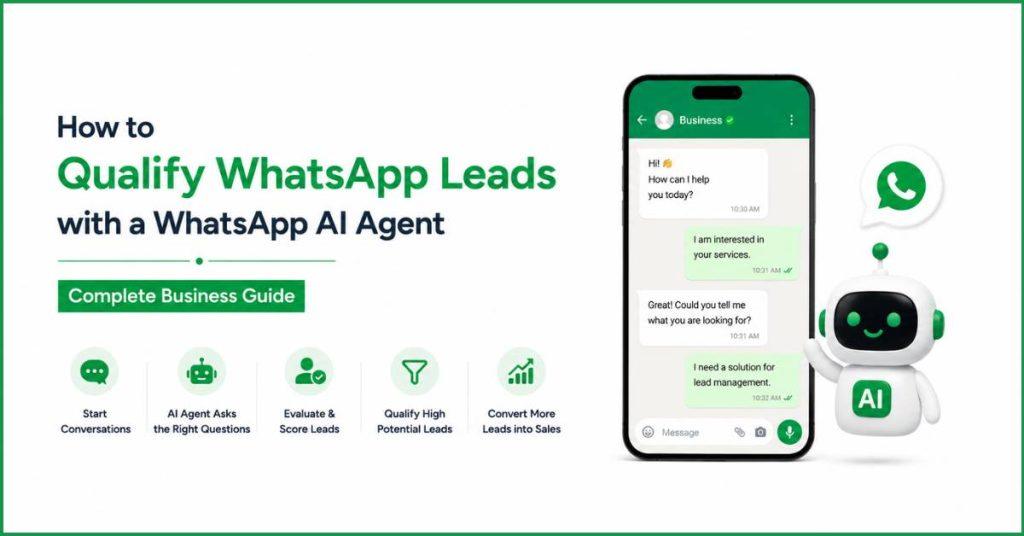
To fix this, companies are using WhatsApp AI Agents. These are smart computer assistants that text back instantly on WhatsApp. They chat naturally with everyone, answer basic questions, and figure out who is actually ready to buy. Once the AI finds a highly qualified customer, it immediately hands the conversation over to a human sales rep to close the deal. Thus, saving time and dramatically boosting sales.
Why Lead Qualification Matters for Business Growth ?
When a business doesn’t check their leads ahead of time, their sales team wastes almost all of their day texting window shoppers who have no money or interest in actually buying anything. Checking and filtering these leads automatically completely fixes this problem. It ensures human workers only spend their valuable time talking to serious buyers. Thus, making the employees much happier and more productive.
Plus, it gives customers a fantastic experience because serious buyers get instant replies on WhatsApp instead of waiting days for a phone call or filling out a long, boring website form. Since the business answers people while they are still excited about the product, they are seven times more likely to make a sale. It turns random messages into successful growth.
Why is WhatsApp Becoming a Lead Qualification Channel ?
Businesses are moving away from old marketing methods like emails and phone calls. It is because most people ignore them, and nobody likes filling out long website forms. Instead, companies are switching to WhatsApp because it is where billions of people already spend their time talking to friends, and almost everyone opens a text message within minutes.
It is a win-win because customers love getting instant answers without any pressure. They are much more willing to chat about what they need over a quick text. By setting up ads that take a customer directly into a WhatsApp chat, businesses can start friendly conversations instantly. It keeps people interested and makes it incredibly easy to see who is actually ready to buy without ever making them leave their favorite app.
What is WhatsApp Lead Qualification?
WhatsApp lead qualification is basically a fast way for a business to figure out if someone texting them is a serious buyer or just bored and browsing. Instead of making people fill out annoying website forms with fake names or emails, the business uses WhatsApp to text back and automatically get the person’s real name and phone number.
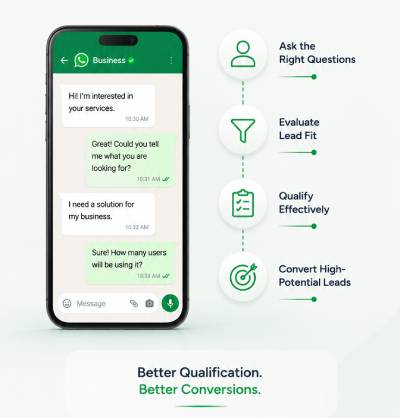
The system then asks a few quick, friendly questions—or uses cool pop-up buttons and mini-menus right inside the chat. It helps to learn what the customer needs, how much money they have to spend, and how fast they want it. Because these questions feel like a normal conversation rather than a test, people are much happier to answer them honestly. This helps the business instantly spot the most excited, ready-to-buy customers so a human worker can help them close the deal right away, while keeping the chat open so they can easily text any distracted customers later on.
Why Traditional Lead Qualification Methods Fall Short ?
The old way businesses check their leads is totally broken. It is because it depends on boring website forms, long emails, and annoying phone calls that nobody wants to answer anymore. When a customer fills out a form, it usually takes hours or even days for a human worker to finally see it and reply, and by then, the customer has already lost interest or bought from a faster competitor.
Plus, paying human employees to call hundreds of random contacts just to filter out fake phone numbers and casual window shoppers is incredibly expensive and wastes everyone’s time. Because human workers get tired or score leads differently depending on how busy they are, the whole process becomes a messy guessing game. This old-school “phone tag” method causes businesses to lose tons of good customers simply because they are too slow and complicated to keep up with the modern world.
What is a WhatsApp AI Agent?
A WhatsApp AI Agent is like a 24/7 digital salesperson. It lives inside a company’s WhatsApp account to chat with customers like a real human. When a person sends a message, Meta’s servers instantly bounce it over to a smart computer brain. It remembers who the customer is, reads the hidden meaning behind their text, even if they use slang, emojis, or make typos—and checks a massive digital rulebook to reply in less than a second.
Instead of getting stuck or forcing people to click frustrating buttons like old-school chatbots, this agent can answer tricky product questions. It figure out exactly what the customer wants to buy, and check their budget through a friendly conversation. The moment the AI spots a highly interested buyer, it uses special connections to save all the customer’s information directly into the company’s records. It sets up a meeting, and hands the chat over to a real human salesman so they can finish the deal.
Difference Between a WhatsApp Chatbot and an AI Agent :
The difference between a basic WhatsApp chatbot and a smart AI agent comes down to how they “think.” A traditional chatbot is like a rigid robot. It can only follow a strict, pre-drawn flowchart; it depends entirely on exact buttons or specific keyword triggers, meaning it will completely freeze or get stuck in an annoying loop if a customer makes a typo or asks a question out of order.
On the other hand, a WhatsApp AI Agent acts like a smart, helpful human assistant because it uses an advanced digital brain to understand normal conversation, slang, and unexpected questions. Instead of forcing users through boring, robotic menus, the AI agent remembers what was said earlier in the chat, answers unique questions on the fly by checking a company’s database, and keeps the conversation feeling completely natural. Because it can handle the messy way people actually talk, the AI agent is much better at keeping customers happy and figuring out exactly who is ready to buy.
Why Are AI Agents Better for Lead Qualification?
Using AI agents for checking leads is a total game-changer for businesses. It is because these smart assistants talk just like real people and never make customers wait. Instead of forcing someone to fill out a long web form, the AI agent has a friendly chat on WhatsApp where it can handle slang or typos effortlessly while secretly scoring the lead in the background based on their budget and timeline.
It automatically changes what it says to match exactly what the customer cares about, and because it works 24/7, it can answer questions or share a calendar link to book a meeting in the middle of the night. By replying in less than a second while the customer is still super excited about the product, the AI prevents people from losing interest or running to a competitor. It helps companies save time and turn way more random clicks into happy, paying customers.
How WhatsApp AI Agents Qualify Leads Automatically ?
A WhatsApp AI Agent acts like an automated assembly line. It turns random online clicks into perfect customers entirely on its own. The second someone clicks an ad, the AI greets them instantly by name on WhatsApp. It automatically saves their real phone number so there is no fake information. It then starts a friendly chat, using helpful pop-up menus and quick tap-buttons to figure out what the customer needs, how much money they have, and when they want to buy. The smart AI brain easily understands messy texting, typos, or slang. It instantly grades the customer behind the scenes to see if they are a serious buyer.
If the customer passes the test, the AI saves all their info into the company’s master records. It drops a calendar link to book a meeting, and pings a human salesman to take over the conversation. Even if the customer gets distracted and stops texting, the AI will send a gentle reminder a few hours later. It helps to pick up right where they left off, ensuring no good lead gets left behind.
Top AI Agent Prompts to Qualify Leads on WhatsApp :
To help you build a highly effective WhatsApp AI Agent, here is a collection of optimized, conversational prompts. These are designed using the BANT and CHAMP frameworks to extract deep qualification data naturally, without making the customer feel like they are being cross-examined.
1. Budget Qualification Prompts
The goal here is to establish spending capacity without sounding overly aggressive or intrusive.
System Instruction / Prompt :
“Act as a friendly business consultant. Your goal is to gently discover the prospect’s budget range. Avoid blunt questions like ‘How much money do you have?’ Instead, present realistic pricing tiers contextually. Offer them choice buttons or quick-reply options to make it low-friction.”
Conversational Execution :
“To make sure we’re looking at the right options, do you have a specific budget tier in mind for this project? For context, most of our growing agencies start with our Growth tier (around $200/month), while larger teams use our Enterprise setup ($1,000+/month). Which bucket feels like the best fit for you?”
2. Need Assessment Prompts
This prompt is designed to uncover the prospect’s deep pain points. It helps to determine if your solution matches their operational reality.
System Instruction / Prompt :
“Act as an empathetic problem solver. Listen to the user’s current workflow issues. Do not pitch the product yet. Ask an open-ended question that encourages them to describe their biggest operational bottleneck in their own words.”
Conversational Execution :
“Got it. Every business handles operations a bit differently! What is the single biggest bottleneck your team is facing right now that made you look for a new solution? (Feel free to reply with a quick text or even drop a quick voice note if that’s easier!)”
3. Purchase Timeline Prompts
Establishing urgency is critical for lead prioritization. It prevents sales reps from chasing cold pipelines.
System Instruction / Prompt :
“Your objective is to determine the user’s launch or purchase timeline. Frame the question around their project success and readiness rather than just a calendar date, making it feel collaborative.”
Conversational Execution :
“That makes total sense, and we can definitely help fix that bottleneck. Ideally, when are you hoping to have this new system fully up, running, and live for your team? Are we looking to solve this within the next couple of weeks, or are you just scouting options for next quarter?”
4. Decision-Maker Identification Prompts
This prompt helps identify if you are speaking with the economic buyer, an evaluator, or an end-user, allowing for proper CRM tagging.
System Instruction / Prompt :
“Identify the stakeholder structure without being insulting. Ask who else on their internal team needs to review the platform or technical specs before making a final decision.”
Conversational Execution :
“Awesome. Since setting this up usually involves a few moving parts, who else on your team will be evaluating this with you? I want to make sure I send over the right technical or pricing summaries for your managers or tech team if they need to peek at it!”
5. Product Interest Discovery Prompts
Use this to narrow down the specific product category, service line, or plan features the user actively requires.
System Instruction / Prompt :
“Act as a product specialist. Present the core pillars of the business using WhatsApp’s interactive list menus or clear bullet points. Ask the user to select the primary path that matches their goal.”
Conversational Execution :
*”To guide you to the right place, which of our core capabilities are you most interested in exploring today?
🟢 A: Full-Scale Marketing Automation
🔵 B: Omnichannel Customer Support Inbox
🟣 C: Custom AI Agent Development
Just reply with A, B, or C, or tap the option below!”*
6. Follow-Up Qualification Prompts
When a user goes dark mid-conversation, this re-engagement prompt breaks the ice. It provides immediate value rather than an annoying “just checking in” message.
System Instruction / Prompt :
“This prompt triggers if a user stops responding for more than 4 hours during a live qualification sequence. Do not sound robotic or demanding. Reference the last point discussed, offer a helping out, and invite them back smoothly.”
Conversational Execution :
“Hey there! Totally understand if things got busy on your end. The last time we chatted, you mentioned wanting to fix your team’s response bottlenecks this month. If you’re still working on that, would you like me to drop a quick 2-minute video showing how we solve it, or should we pause for now?”

The Botbuz AI Agent Framework for Lead Qualification :
The Botbuz AI Agent Framework is production-ready. The conversational architecture designed to automate the entire customer acquisition lifecycle on WhatsApp. By combining native Meta interface assets with an advanced large language model (LLM) reasoning layer, the Botbuz framework systemizes how growing businesses capture, score, and route inbound prospects.
1. Lead Capture
The Botbuz framework initiates the moment a prospect interacts with an entry point, such as clicking a Click-to-WhatsApp (CTWA) ad or scanning a local QR code.
Instead of routing users to an external landing page, Botbuz instantly triggers a native webhook. The framework automatically captures the user’s verified phone number and WhatsApp profile name directly from Meta’s payload. Thus, eliminating the risk of fake or typo-ridden contact details.
2. AI-Powered Qualification
Once the contact session is initialized, the Botbuz context orchestrator deploys a dynamic, conversational agent rather than a rigid rule-based flowchart.
The AI agent utilizes advanced Natural Language Understanding (NLU). It helps to conduct fluid discovery using frameworks like BANT or CHAMP. To maximize completion rates, the Botbuz engine injects interactive elements natively into the chat stream:
WhatsApp Flows: For structured, low-friction interactions (such as multi-step discovery forms or scheduling inputs) that open directly inside the chat screen.
List Menus & Quick Replies: For single-tap data choices like defining an industry or choosing a feature requirement.
3. Lead Scoring
As the user interacts with the agent whether typing out free-form text or tapping buttons—the Botbuz reasoning engine parses the conversation in real time.
The framework evaluates the prospect’s inputs against preconfigured Ideal Customer Profiles (ICPs). The system assigns weighted mathematical points to key variables such as budget alignment, immediate timeline, and decision-making authority. It helps to dynamically calculate an active lead score behind the scenes.
4. CRM Integration
Data isolation is a major bottleneck in modern sales pipelines. The Botbuz architecture resolves this by employing real-time function calling and webhook arrays.
The second a data point is revealed or a score changes. The framework automatically updates your revenue stack (e.g., HubSpot, Salesforce, or Zoho). It securely writes back the verified phone number, structural chat summaries, intent tags, and the exact qualification score without requiring manual data entry.
5. Sales Team Escalation
When a prospect’s real-time score crosses your custom “Sales-Ready” threshold, Botbuz executes an intelligent human handoff protocol.
The system triggers an API request that routes the entire active WhatsApp thread directly to a human closing team’s central inbox. Along with the live chat, the closing agent receives a concise, structured summary generated by the AI detailing the prospect’s exact pain points, budget, and constraints, ensuring a seamless, highly informed transition.
6. Continuous Follow-Up Automation
If a user goes quiet midway through a qualification sequence, the Botbuz persistence engine takes over.
Because the conversation thread remains natively open on the user’s mobile device, the framework schedules automated, timed follow-up nudges based on user behavior. These context-aware reminders pick up exactly where the customer left off. It offers helpful resources or interactive options to re-engage cold leads with zero manual oversight.
How to Build a WhatsApp AI Agent for Lead Qualification with Botbuz :
1.Define Goals : Establish ICP and BANT criteria. Set the specific budget thresholds, timelines, and data fields your sales team requires to consider a lead qualified.
2.Build Workflows :
Design the Botbuz canvas architecture.
Map out your welcome triggers & embed interactive WhatsApp Flows, List Menus, and Quick Replies into the system canvas.
3.Configure Prompts:
Program the AI reasoning engine.
Write explicit system prompts to lock down the agent’s persona. Attach product catalogs for RAG-driven data retrieval.
4.Sync CRM Tools :
Authenticate webhooks and function calls.
Connect your account to HubSpot or Salesforce via API, mapping AI data extractions directly to your master customer records.
5.Sandbox Testing:
Simulate edge cases and refine logic.
Run mock chats using slang, typos, and unexpected side questions to ensure prompt guardrails hold up under real-world pressure.
6.Live Launch:
Deploy to production and track analytics.
Link the bot to your live API number. Connect your Click-to-WhatsApp ads, and monitor conversation data on your analytics dashboard.
Is Botbuz the Right WhatsApp AI Platform for Your Team?
Deciding if Botbuz is the right tool comes down to whether a company wants to stop using old-school, rigid button menus and upgrade to a super-smart messaging strategy. It is perfect for fast-moving businesses like real estate offices, insurance companies, and online stores that get flooded with hundreds of text messages every single day and need to reply to buyers instantly before they lose interest.
Instead of typing text by hand, companies use Botbuz. It is because its smart AI handles messy typos, reads regional slang, opens up mini-forms right inside the chat window, and saves all customer notes straight into the company’s master database. By switching to an automated assistant that instantly checks every lead’s budget and coordinates everything around the clock, companies can stop wasting money on slow callbacks, effortlessly handle thousands of buyers at the exact same time, and make way more sales out of their social media advertisements.
Conclusion :
In short, moving from old-school web forms to a WhatsApp AI Agent is the ultimate shortcut. It turns online clicks into real customers. By using a platform like Botbuz, a business gets an incredibly smart digital assistant. It greets buyers instantly, effortlessly handles messy texting, and checks their budget through a natural conversation. It completely eliminates waiting times and tedious typing, automatically saving every detail into the company’s records while instantly sending the best buyers directly to the sales team. Ultimately, deploying this technology means less wasted money on ads, zero missed opportunities, and a smooth, modern shopping experience that keeps customers happy around the clock.